Nick Cave on the worst thing about becoming a really old rockstar. Which, it turns out, is just one variation on the worst thing about anything that goes on a while. Nicely written though.
Category: Personal
Rationing in Wartime
Sitting in a suburban cafe in the afternoon of this last drawn-out day of this long Easter weekend. On the table, a couple of second-hand books and a map from the Oxfam shop. Earl Grey in a fat, purple-brown pot. The map is older than I am — whereas I am exactly the same age, and many of the cafe’s customers are rather less so.
Early spring blue sky outside, and that freeing but vulnerable feeling of being out without a coat after another too-long winter. The sunlight floods in through the tall sash windows, casting faces half in shadow half in light.
No dangers here in this bustling place, except lurking inner thoughts. The daily struggle to comprehend that there really are overlapping wars going on, east of here, in their evening of this same day, in this newly bright year. Shredded bodies in ditches. Ruined schools and homes. Automated, patiently-lethal weapons. People being slaughtered in the new, casually cruel way that we have now; as well as in all of the old ways. Push down on those thoughts and reach for distraction —
open one of my new-old books at random, and Polly Atkin serves it up raw:
but it is 1793 and in the square the women are knitting
and it is 2011 and in the square the tanks are coming
and it is 1989 and in the square the tanks are coming
and the soldiers are coming the soldiers are always coming
…
and it is 2010 and you are thinking it can never
get worse than this, and it is 2015
and worse, and 2017 and worse,
this is it, you are sure this is it, it is worst 1
Try to coax my mind back to safety and what to cook for tea tonight — and I think paella. Use-up those lemons, and the peppers. And then I remember where saffron mostly comes from, and why there’s none to be had.
A man and a toddler walk hand-in-hand past my table, the child stepping with that wobbly-proud concentration that is actually effortless grace. And passing out of my view.
Just the late afternoon of another day stolen from responsibility. Work tomorrow. Shirts to iron. Half-welcome distractions.
- From An Aubade Upon St. Lucy’s Day, by Polly Atkin. Published in Much With Body, Seren Books, 2021. ↩︎
A Forester’s Tale
You had wanted to be a forester for a long time. On childhood walks in the forest with your parents, the stacked piles of cut logs fascinated you: clearly the result of human skill, but somehow also still a part of the forest. Each log different. Each pile unique.
As an adult you found work and, each morning, you headed out into the wide, enveloping forest with your axe. Years passed, and you cultivated your skills as a forester.
Then they came to you and told you that the world had changed, and that you had to use a chainsaw. They said that chainsaws were the future. So you learned to wield one: the difference between cutting and chopping; how to hold your body; necessary maintenance; the angle and stroke of the file to sharpen the chain. Years passed. The labour, like the forest, seemed endless, and you continued to develop your skills.
Then they came to you again and told you that the world had changed, and that you had to sit in a room in a building in an office park in the city and supervise a fleet of robotic tree-harvesting agents. The machines never stopped, they said, and were better at chopping-down trees than people were, and more productive. They said that this was the future.
So you learned how to use the remote controls, the telepresence headset, and the communication systems. Each day you devised a harvesting plan for your team, even though the machines were almost completely autonomous. And the air in that room was grey and stale.
And that was when you realised that, for you, it was never about chopping down trees, or the height of the log-pile. It was always about being in the forest.
Status II
Status I
Loss as the Price of Love
It is perhaps a truism that to love is to acknowledge the inevitability of loss. Either by time or circumstances, all that you love will be lost. People will change, depart, die, eventually become dust. Nothing lasts, and we will lose all that we love. But still we love anyway.
This has been on my mind recently, and I was struck by this quote from an author whom I hadn’t encountered before.
“Life will break you. Nobody can protect you from that, and living alone won’t either, for solitude will also break you with its yearning. You have to love. You have to feel. It is the reason you are here on earth. You are here to risk your heart. You are here to be swallowed up. And when it happens that you are broken, or betrayed, or left, or hurt, or death brushes near, let yourself sit by an apple tree and listen to the apples falling all around you in heaps, wasting their sweetness. Tell yourself that you tasted as many as you could.”
— From The Painted Drum by Louise Erdrich1
This morning, as I left for work, there were plump, ripe apples on the tree in the front garden of my house. A reminder not just of the start of autumn here in the northern hemisphere, but also that things of sustaining wonder can persist and recur over your whole life.
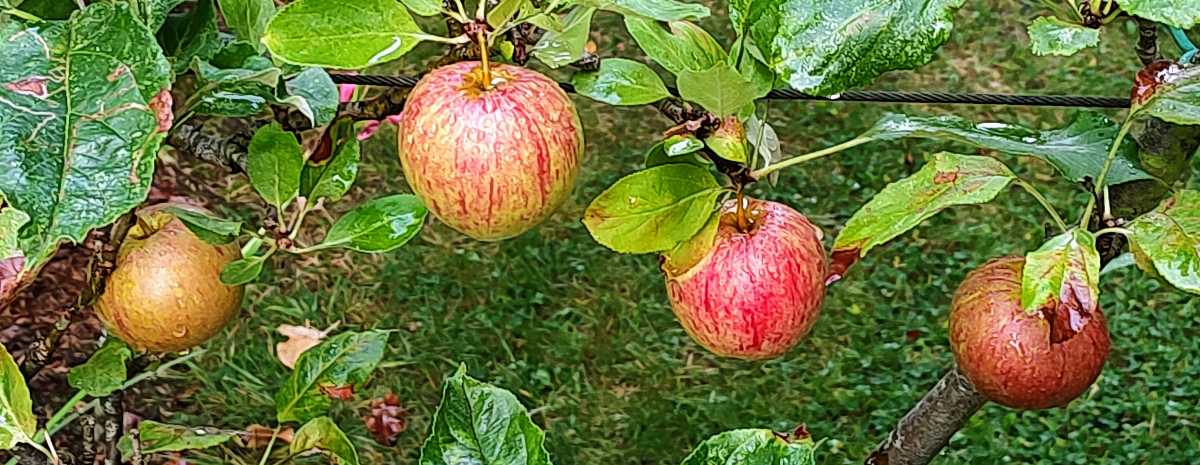
And, inevitably, a reminder too that sometimes that which is wonderful does not last — and can be taken from you, and be betrayed and ruined, and become forever lost.
Time is shorter than you remember.
- Via the wonderful Maria Popova ↩︎
A Christmas Memory
Someone on HN asked: What are some of your favorite memories from Christmas? Many comments were about video games or consoles or first PCs. Here’s what I wrote, lightly expanded and edited.
—
I was born in the late 60s, so none of my earlier childhood Christmas memories involve digital technology. But one that stands out was the year that I got a telescope for Christmas.
I was maybe about ten. It was fairly average, cheap refractor on a wooden tripod. But growing up in an environment where things like that weren’t the norm, I didn’t understand that at the time. This was the era of Viking and Voyager and the Grand Tour, so I was very pleased.
On Christmas day my family, my aunts and uncles and cousins, would all cram themselves into my grandparent’s small council house for Christmas dinner. Then the kids would play with their toys and try not to get stood on by the slighly tipsy adults. There were too many people in too small a space, I realise now, but I have happy memories of those days.
When it got dark, that year, I took my new scope out into my grandparent’s small front garden to look at the moon and to try (unsuccessfully because, as I later realised, it lacked the resolving power) to locate a planet or two. The moon looked coldly beautiful, and I remember seeing craters and features in much more detail than I ever had before. I was hooked.
It was very cold that day, in a way that it doesn’t ever seem to be at Christmas anymore. People wandering past, walking dogs or maybe going to visit friends or to the pub, kept asking me what I was doing. I could hear everyone indoors, talking and laughing. Eventually it started to snow very lightly, so I packed up my gear and stood watching the thin snowfall for a while – drifting over the unlit space above the land drain that their house faced onto – and then went back indoors.
That was more than forty years ago. My grandparents are long dead and their house no longer exists. Many of the other adults who were there then have also died. But I still remember how my universe suddenly got vastly bigger that Christmas day. And I remember the snowflakes drifting down in the dark.
A few years ago I passed that telescope on to a five year old friend. I don’t know what, if anything, she makes of it though. We live in a different age of wonders, with images from the Hubble and James Webb available on any screen. Different times, as it should be.
Merry Christmas everyone.
Small Progress
& I am tired
From It’s 6 am & the Sun Is Out by KB Brookins
of making peace with small
progress being a precursor
for my death
Link, via Erin Watson
Year End
“This is what you shall do: Love the earth and sun and the animals, despise riches, give alms to every one that asks, stand up for the stupid and crazy, devote your income and labor to others, hate tyrants, argue not concerning God, have patience and indulgence toward the people, take off your hat to nothing known or unknown or to any man or number of men, go freely with powerful uneducated persons and with the young and with the mothers of families, read these leaves in the open air every season of every year of your life, re-examine all you have been told at school or church or in any book, dismiss whatever insults your own soul, and your very flesh shall be a great poem and have the richest fluency not only in its words but in the silent lines of its lips and face and between the lashes of your eyes and in every motion and joint of your body.”
Walt Whitman, preface to Leaves of Grass, via Maria Popova
Happy new year. Maybe, just maybe, although I can’t see how, 2024 might just be better less bad than the one ending. We’re all going to have to try pretty hard though.
Time to burn the dying year down and start again.
Early Christmas Present
Wordle 917 1/6
🟩🟩🟩🟩🟩
After 670 games played, my first 1/6.